Silver is the metal people most often underestimate and most often overpay for. Underestimate, because a chest of grandmother's flatware feels like clutter rather than an asset. Overpay for, because a great deal of what looks like silver is plate over base metal and is worth almost nothing by weight. Both of those problems are solved in about ten minutes at a counter with a scale and a test kit on it.
We buy silver the same way we buy gold in Kelowna: by purity and by weight, with the testing done where you can see it, and with a guarantee to match or beat any quote in the Okanagan Valley.
Sterling, plate, and the difference that matters
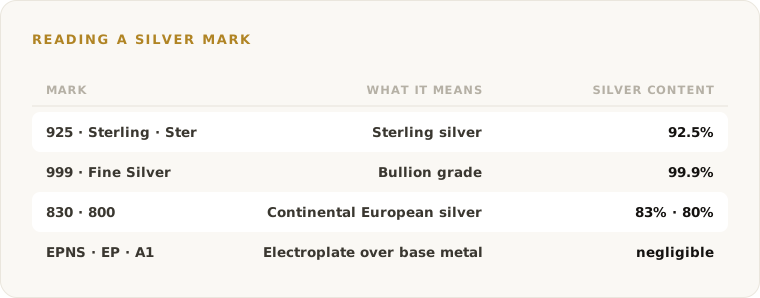
Sterling silver is 92.5 percent pure, which is why it is stamped 925, Sterling or Ster. That stamp is the single most important thing on the piece. Silver plate is a microscopically thin layer of silver bonded to nickel, copper or brass, and the recoverable metal in it is negligible. Plate is usually marked EPNS, EP, A1, Silver on Copper, or with a maker's name and no purity number at all.
We check for these marks first, because it changes the conversation immediately. If your tray is plate, we will tell you that rather than making you a token offer, and you can keep it and use it. If it is sterling, we weigh it.
Silverware and flatware sets
Sterling flatware is the most common silver we see in Kelowna, usually inherited, usually in a fitted wooden canteen, and usually unused for twenty years. A few things are worth knowing before you bring it in.
- Sterling knives are almost always weighted. The blade is stainless and the hollow handle is filled with pitch, resin or cement to give it heft. Only the silver shell counts toward the weight, so knives are priced separately from spoons and forks.
- Candlesticks and some bases are also weighted or loaded for stability, for the same reason and with the same result.
- Monograms, engraving and family initials do not reduce the metal value at all.
- Incomplete sets are fine. Nine forks and four spoons are worth what nine forks and four spoons weigh.
- Hollowware such as teapots, trays, bowls and water pitchers is bought the same way, once the base and any weighting are accounted for.
If a set is in good condition, complete, and by a known maker, we will say so, because in some cases a complete set is worth more to a collector than it is as metal, and you deserve to know that before you sell it to anyone.
Silver coins and Canadian junk silver
Canadian circulation coins carried real silver for a long time, and a great many Okanagan households still have a jar of it. Dimes, quarters, half dollars and dollars dated 1966 and earlier are 80 percent silver. Some 1967 and 1968 coins were struck at 50 percent as the mint transitioned, and after 1968 the silver was gone entirely. Anything with a maple leaf and a 9999 mark is modern bullion and is close to pure.
We buy all of it: Canadian and American circulated coins, commemoratives, Maple Leafs, Eagles, silver rounds, and poured or minted bars in any size. Coins are weighed and calculated by their silver content, and if a coin has genuine numismatic value above its metal content, we will point that out rather than melting it past you.
How the price is calculated
Silver trades globally in troy ounces, and a troy ounce is 31.1 grams. The market price moves daily, sometimes sharply, and it is the starting point for everything. From there the calculation is straightforward: the weight of the item, multiplied by its purity, priced against the market figure on the day. We show you the market figure we are using, we weigh in front of you, and we do the arithmetic where you can follow it.
One honest caveat specific to silver: because silver is worth far less per gram than gold, volume matters. A single sterling ring is a small transaction. A full flatware canteen, a tea service and a jar of pre-1967 coins together is a meaningful one. It is usually worth bringing everything in one visit rather than testing the waters with one piece.
Your visit
Bring the lot, in whatever bag or box it lives in. We sort it into sterling, plate, coins and bullion, test anything unmarked, weigh each group, and give you a number per group and a total. The estimate is free and carries no obligation, and you are welcome to take the figure elsewhere and compare it. Our free estimates page explains exactly how the appointment runs.
We are at Unit 301, 478 Bernard Avenue, ScotiaBank Building, third floor, Downtown Kelowna, BC V1Y 6N7, open Monday to Sunday, 9 AM to 5 PM. Appointments are preferred, walk-ins welcome. Call +1 (250) 860-0096, or +1 866-872-0096 toll free, and please bring government-issued photo ID, since every purchase we make is recorded as licensed buyers.
