
People ask us this over the phone every day, and the honest answer is always the same: we cannot tell you until we have weighed and tested the pieces. That sounds like a dodge. It is not. By the end of this article you will understand exactly why, and more usefully, you will be able to sit at any buyer's counter in the Okanagan and follow their maths line by line.
The three numbers, and nothing else
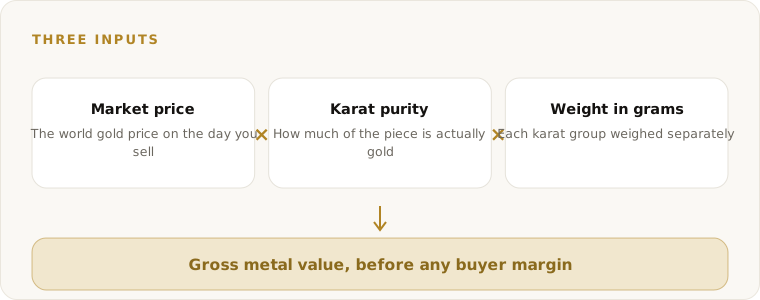
A scrap gold offer is built from three inputs and one formula. There is no fourth input, and if a buyer introduces one, ask what it is.
- The market price of gold on the day, which is the same for everyone on earth and changes constantly.
- The purity of each piece, expressed in karats.
- The weight in grams, of each purity group separately.
Multiply purity by weight and you have the amount of pure gold in front of you. Price that against the market and you have the gross metal value. What a buyer offers you is a percentage of that figure, and how large that percentage is depends entirely on where that buyer sits in the supply chain.
Spot price and what you actually get paid
The number you find when you search the gold price is the spot price: the price of one troy ounce of pure gold on the world market, quoted for institutional-scale trades of refined bullion. A troy ounce is 31.1 grams, so dividing gives you the spot price per gram of pure gold.
Nobody pays a member of the public full spot for a broken 14k chain, and any buyer who says they do is recovering the difference somewhere you cannot see. Here is why the gap exists, plainly:
- Your chain is not pure gold. It is 58.5 percent gold and 41.5 percent copper, silver, nickel or zinc. Separating those costs money.
- Refining has a real cost per batch, and small batches cost proportionally more.
- The buyer carries the market risk between buying your gold and doing something with it, and gold can move several percent in a week.
- Every business in the chain needs a margin to exist.
That last point is the one that matters most to your final number. If your gold passes from a pawn shop to a dealer to a refiner to a manufacturer, four businesses take a margin and all four come out of your side. We are a working jewellery manufacturer, so we are the end of that chain rather than the start of it, and the margins in between do not get taken. That is the whole mechanism behind our match or beat guarantee, and it is why we tell people to shop around first.
Karat purity, in actual numbers
Karat is a fraction out of 24. That is all it is. Pure gold is 24 parts out of 24, and everything else is a proportion.
- 24k is 99.9 percent gold
- 22k is 91.7 percent gold
- 18k is 75 percent gold
- 14k is 58.5 percent gold
- 10k is 41.7 percent gold, the lowest that can legally be called gold in Canada
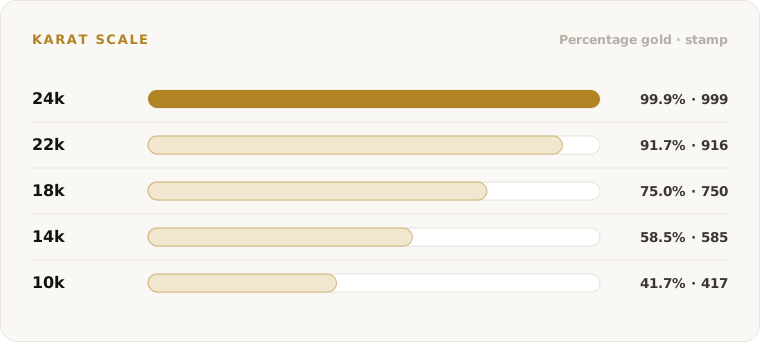
European and modern stamps express the same thing as parts per thousand, so 750 is 18k, 585 is 14k and 417 is 10k. Those two systems tripping people up is common enough that we wrote a separate guide to what your karat stamps actually mean, including the plated marks such as GP, GF, HGE and RGP that look like gold marks but are not.
The practical consequence: an 18k ring is worth roughly 28 percent more per gram than a 14k ring of identical weight, and a 10k ring is worth less than a third of a 22k one. This is why mixing everything into one pile and asking for a single number is the most expensive thing you can do. Sorted piles get priced precisely. Mixed piles get priced conservatively, by everyone.
A worked example
Real market prices change daily, so instead of quoting one that will be wrong by the time you read this, assume a round figure purely for the arithmetic. Say the price being used works out to $100 per gram of pure gold. The real number on the day will be different, and any buyer worth dealing with will show you the one they are using.
You bring in a jewellery box containing:
- A broken 14k chain weighing 12 grams
- A 14k ring weighing 4 grams
- An 18k pendant weighing 6 grams
- A gold-plated bangle weighing 30 grams
The 14k items are grouped and weighed together: 16 grams total. At 58.5 percent purity, that is 16 x 0.585 = 9.36 grams of pure gold. At our assumed $100 per gram, the pure gold content is worth $936.
The 18k pendant is weighed separately: 6 grams at 75 percent purity is 4.5 grams of pure gold, worth $450 on the same assumption.
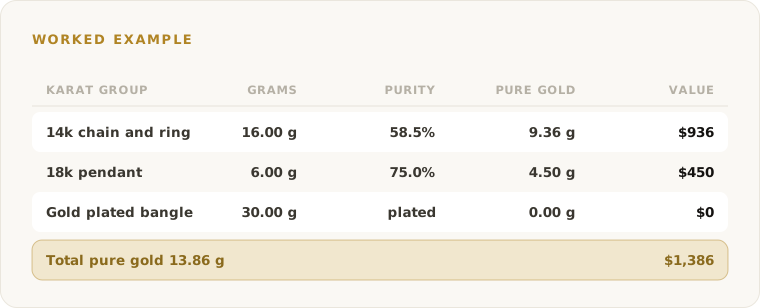
Together, 13.86 grams of pure gold, with a gross metal value of $1,386. Your offer is a percentage of that figure, and the fewer businesses standing between you and the person who will actually use the metal, the closer to it you land.
The 30 gram bangle is worth nothing in this calculation. Plating is measured in microns and there is not enough recoverable gold in it to bother with. It weighs more than everything else combined and contributes zero, which is exactly the sort of surprise that is better delivered at a counter than discovered afterwards.
How weighing and testing actually happen
You should be able to watch every part of this, and if you cannot, that is the signal to leave.
Sorting
Items are grouped by stamp first. This is quick, and it is done in front of you.
Testing
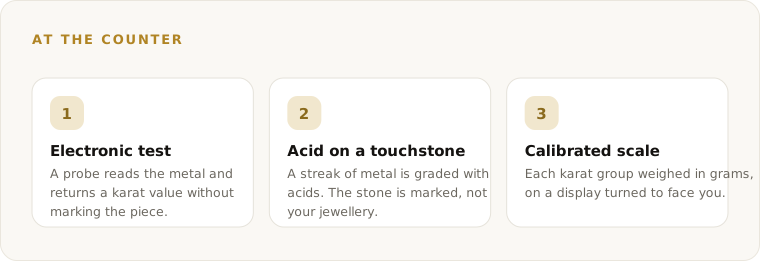
A stamp is a claim, not proof. Stamps wear away, they get lost when a ring is resized, and plated goods are frequently marked in ways designed to look convincing. So every piece gets tested. Electronic testers read the metal's properties through a probe placed on the surface and give a karat reading without marking the piece. Acid testing uses a touchstone: the piece is rubbed on the stone to leave a small streak of metal, and graded acids are applied to the streak. The streak dissolves or survives depending on purity. It marks the stone, not your jewellery.
Where a piece might be plated, a small file mark on an inconspicuous edge shows whether the gold goes all the way through or stops at the surface. We ask before doing this, every time.
Weighing
Each karat group is weighed separately on a calibrated scale positioned so you can read the display. Grams, not ounces, and one weight per group, not one for the whole pile.
What moves the number day to day
The gold price is set globally and reacts to interest rates, currency movements, central bank buying and general uncertainty. For a seller in Kelowna, three practical points follow.
First, a quote from three weeks ago is not a quote today. Second, the Canadian dollar matters as much as the gold price itself, because gold is priced internationally in US dollars, so a weaker loonie raises the Canadian gold price even when the world price has not moved. Third, day-to-day movement is usually small relative to the difference between buyers. Choosing a better buyer will almost always affect your total more than choosing a better day.
What does not change the number at all
This is the section that saves people the most money, because every item on this list is something sellers routinely spend time or money on for no return.
- Cleaning and polishing. Tarnish and dirt are surface conditions. They do not alter the metal content. Professional polishing before a sale is money out the door.
- Repairs. A broken chain weighs the same as a fixed chain. Do not pay a jeweller to solder something you are about to sell.
- What you paid at retail. The original price included design, branding, retail rent, staff and markup, none of which exist in the metal. This is the hardest one to accept and the most important to understand.
- Sentimental value. Real, and completely uncorrelated with the gram weight. If a piece matters to you, that is a reason to keep it or have it remade, not a reason to expect a higher offer.
- Insurance appraisal figures. Appraisals are written at replacement value, which is what a comparable new item costs at full retail. Comparing that to a cash offer compares two different measurements taken for two different purposes.
- Damage and missing pieces. One earring, a bent ring, a snapped clasp. All valued per gram, exactly like an intact piece.
What to bring
- Everything, including the items you assume are worthless. Unstamped and broken pieces frequently turn out to be solid gold.
- Government-issued photo ID. Licensed buyers record every purchase against ID, which is what keeps stolen goods out of the market and protects honest sellers.
- Any written quote you have already been given, because we guarantee to match or beat any offer in Kelowna and the Okanagan Valley.
Leave the polish and the repair budget at home.
The only reliable way to find out
Everything above is the theory. The number itself needs a scale and a test kit, which is why our free gold estimates in Kelowna exist and why they carry no obligation. Fifteen minutes, no fee, and you leave with a firm figure whether or not you sell. If you want the detail on how each category is assessed, our page on selling gold in Kelowna covers what we buy and how we test it.
And if you take one thing from this article, take this: get more than one quote. We say that as buyers, and we mean it.
Frequently asked questions
How much is a gram of 14k gold worth in Kelowna?
A gram of 14k gold contains 0.585 grams of pure gold, so its value is 58.5 percent of the market price per gram of pure gold on the day, less the buyer's margin. Because the market price changes every business day and buyers' margins vary widely depending on where they sit in the supply chain, the only accurate figure is one calculated in front of you with the actual weight and the day's price.
Why is the offer lower than the spot price of gold?
Spot price is the price of one troy ounce of pure refined gold in institutional quantities. Your jewellery is alloyed, not pure, and it has to be refined at a real cost before it can become pure gold again. On top of that, every business between you and the eventual end user takes a margin. The fewer of those businesses there are, the closer to spot your offer lands.
Does the gold price change every day?
Yes. Gold trades globally and moves every business day, driven by interest rates, currency movements, central bank activity and general market uncertainty. For Canadian sellers the exchange rate matters too, because gold is priced internationally in US dollars. Day-to-day movement is usually smaller than the difference between one buyer and another, so choosing the right buyer generally matters more than choosing the right day.
Does my gold need to be stamped to be valued?
No. Missing and worn stamps are very common, particularly on older pieces and anything that has been resized. Unstamped items are tested electronically or with acid on a touchstone, and the test result rather than the stamp is what determines purity. Testing takes seconds per piece and is done at the counter where you can watch it.